
Paella gigante: one pan for a hundred thousand people
In Spain, paella is sometimes cooked for an entire village, and now and then for an entire city. In 1992, more than a hundred thousand people in Valencia ate from a single pan twenty metres across. A story about giant pans, record attempts, a washing-up liquid commercial and the question of how big a paella can get before it stops being a paella.
I once saw it for myself: a Spanish village in the middle of its fiesta, and in the square a single paella pan that fed the whole village. Not several pans side by side, but one pan for everyone. That image has stayed with me ever since. Normally you share a paella with family or friends. There, the whole village sat down at the same table.
Dig a little deeper and you find it can go much bigger. From a few hundred servings to a whole village, to thousands of people, and eventually to a hundred thousand. Time to find out how that actually works, who is behind it, and whether a pan that size can still produce a good paella.
The paella gigante
In Spain the phenomenon has a name of its own: the paella gigante. You come across it at the fiestas patronales, the feast days of a village's patron saint, but also at club celebrations, sporting events, company parties and demonstrations. It fits with what paella has always been: a dish that brings people together around one pan. A paella gigante simply takes that idea and scales it up, quite literally.
It is nothing new. As early as September 1973, a giant paella was cooked in Bajamar, on Tenerife, with 900 kilos of rice and a thousand chickens, among other things. It even made the NO-DO, the cinema newsreel of the Franco era. Today a whole industry has grown up around it: teams that travel to events with huge pans, burners or wood fires, ingredients and cooks, and prepare hundreds or even thousands of servings at once.
8 March 1992: the official world record
The largest paella officially recognised by Guinness World Records was cooked in Valencia on 8 March 1992, in the run-up to the Fallas festival. Its measured weight: 27,215.15 kilos, just over 27 tonnes. More than a hundred thousand people ate from it.
The record was the work of Antonio Galbis and Manuel Velarte, each with a team of around sixty helpers. Guinness, incidentally, lists Juan Carlos Galbis as the record holder; Spanish sources almost all refer to Antonio. The shopping list, according to Guinness: 5,000 kilos of rice, 12,500 litres of water, 1,000 litres of olive oil, 150 kilos of salt, 6,200 kilos of chicken, 2,600 kilos of rabbit, 400 kilos of duck, 2,600 rabbit livers, 1,000 kilos of snails, 5,000 kilos of vegetables and 8 kilos of herbs and spices.
If you have read my step-by-step blog, you will recognise the basis: chicken, rabbit, snails and vegetables. At heart it was a Paella Valenciana, just made for an entire city.
A pan built like a structure
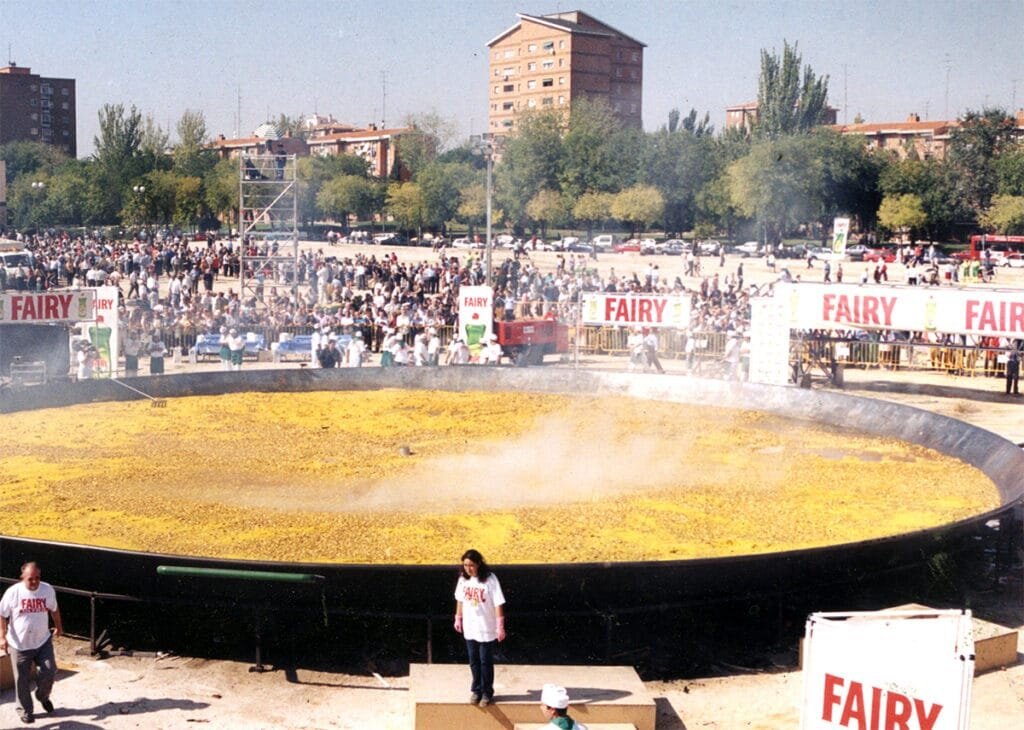
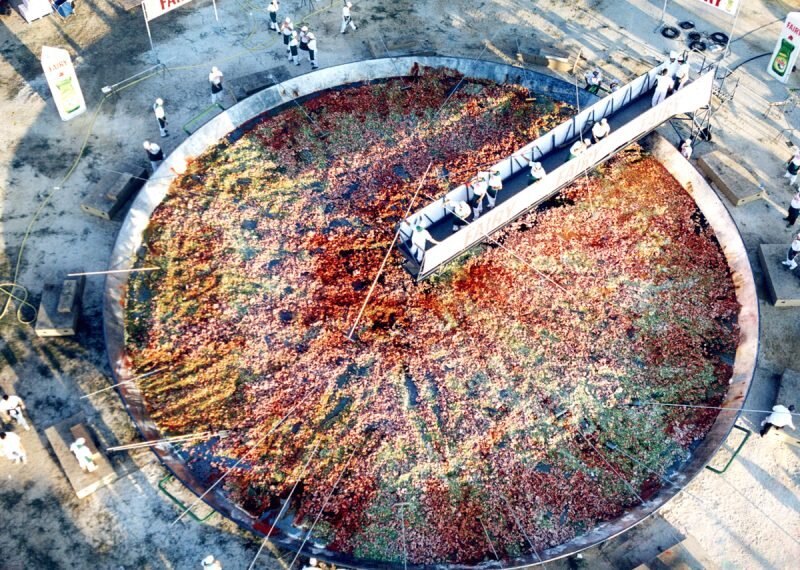
At this scale, cooking becomes something close to civil engineering. According to Spanish sources, the 1992 pan was twenty metres in diameter, with a rim 1.70 metres high. That gives a cooking surface of more than 300 square metres, larger than the floor area of most restaurants. Afterwards the pan stood for some time in the old bed of the Turia, the park that runs right through Valencia. Moving it was clearly not a simple job.
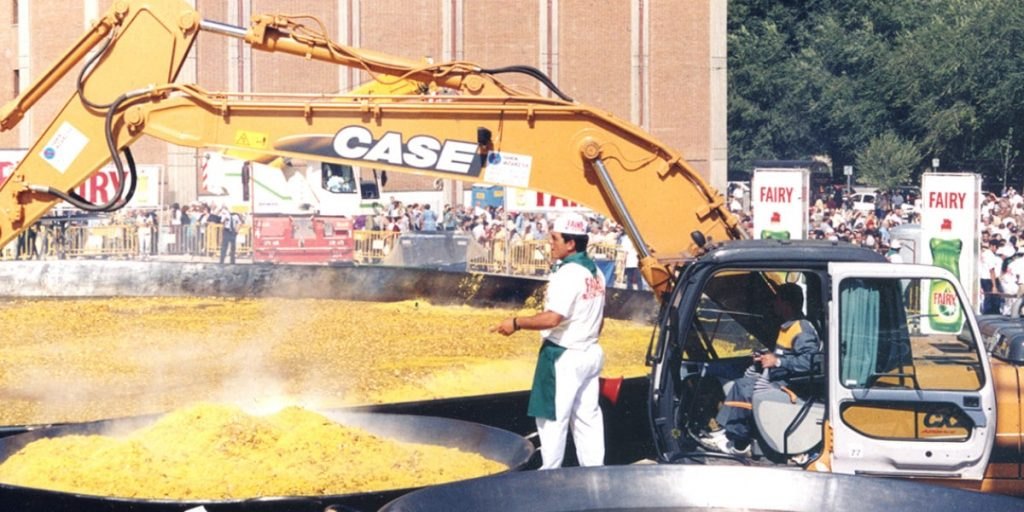
You don't buy a pan like that in a shop. For the 2001 giant paella, a pan was built from ship's steel plate, more than 21 metres across. It arrived in sections, was lifted into place with a crane and welded together on site. According to Galbis, the cooking surface then had to be polished four times to remove rust and welding residue before a single drop of oil could go in. The fire has to be controlled across that entire surface, and the team has to work in different parts of the pan at the same time. At that point, the recipe is only one part of the problem.
Moratalaz 2001: bigger, but not in Guinness
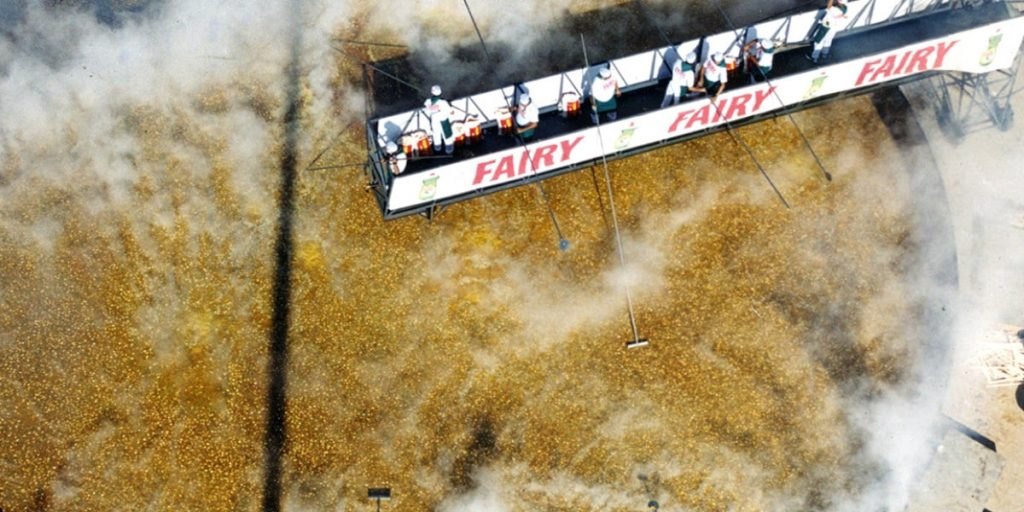
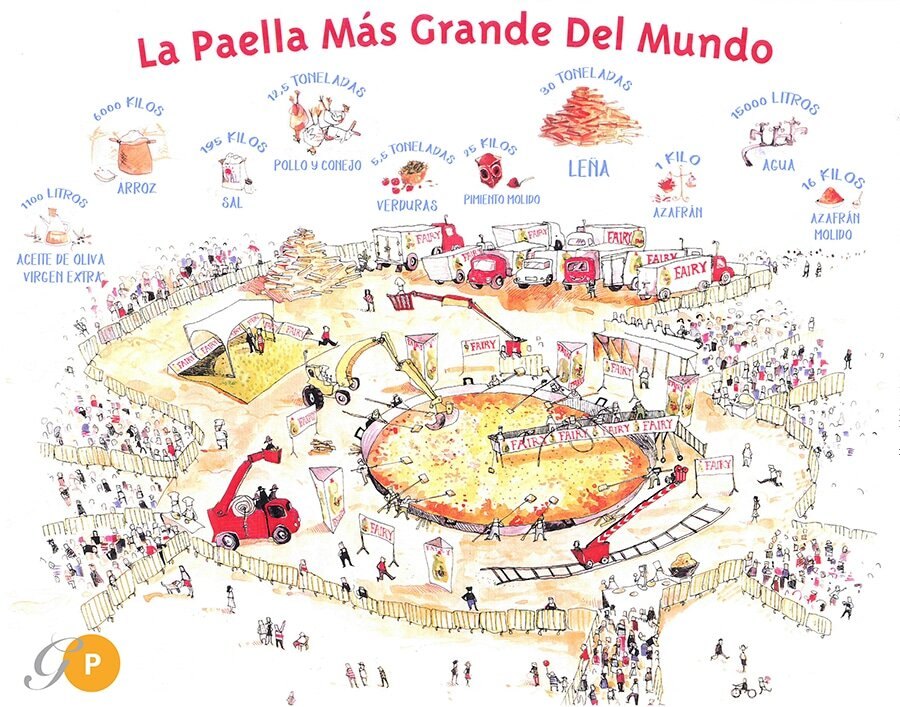
Nine years later, on 2 October 2001, Galbis set out to beat his own record, this time in Moratalaz, a district of Madrid. According to Galbis, around 110,000 servings were made, using 6,000 kilos of rice, 5,500 kilos of vegetables, 12,500 kilos of chicken, rabbit and duck, 1,100 litres of olive oil, 15,000 litres of water and a kilo of saffron, among other things. Some 30,000 kilos of firewood went under the pan. Around eighty cooks worked on the paella for four hours. A walkway ran across the middle so that they could reach the centre of the pan with enormous shovels.
There is a caveat, though. Galbis and much of the Spanish media present Moratalaz as the new world record. But look at the Guinness database today and the record listed is still the 1992 paella from Valencia. I have not been able to find out why Madrid is missing. So this is where I leave it: officially the record belongs to Valencia; according to Galbis himself, Madrid was bigger.
Galbis started out in 1966 as a bar-restaurant in L'Alcúdia, south of Valencia, and is regarded as the first company in the world to specialise in giant paellas. Antonio Galbis has since passed away; his daughter Gema now runs the business. The spot in Moratalaz where the record pan once stood is now home to a bus station and a supermarket.
Villarriba, Villabajo and the washing-up
Mention a giant paella in Spain and many people immediately think of Villarriba and Villabajo. They are two fictional villages from a commercial for Fairy washing-up liquid, which is sold in the Netherlands as Dreft. In the 1991 advert, both villages celebrate their fiesta with an enormous paella. Then the pan has to be washed. In Villarriba, with Fairy, they are done in no time and the party carries on. In Villabajo they are still scrubbing well into the evening.
A simple joke, with a huge effect. Fairy's market share in Spain rose from around 6 to 40 percent, and film director Luis García Berlanga even turned the idea into a TV series in 1994. In Spain, Villarriba and Villabajo are still household names.
And here is the best part: the Moratalaz paella was commissioned by Procter & Gamble, the maker of Fairy. After serving, the 21-metre pan was washed with a single one-litre bottle of Fairy, and the 16,621 dirty plates with another. The commercial invented a giant paella to sell a washing-up liquid, and ten years later a real giant paella was cooked for that very same washing-up liquid.
When it goes wrong: Oran 2015
Not every record attempt ends with a hundred thousand satisfied diners. In 2015, an attempt was made in the Algerian port city of Oran to break the Spanish record. According to Spanish reports, the fire under the pan got out of control and the fire brigade had to step in. What was meant to be a new world record turned into a blaze within minutes.
The footage shows clearly where the real challenge lies. At this scale, the fire, the structure and the safety of the public matter at least as much as the recipe. A twenty-metre pan also means a twenty-metre fire.
And in the Netherlands? Westerbork
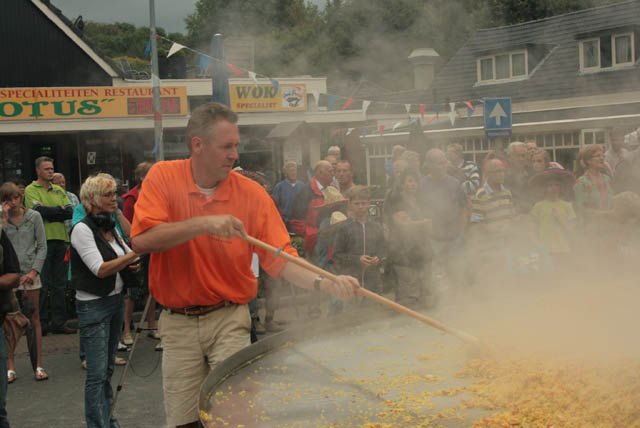
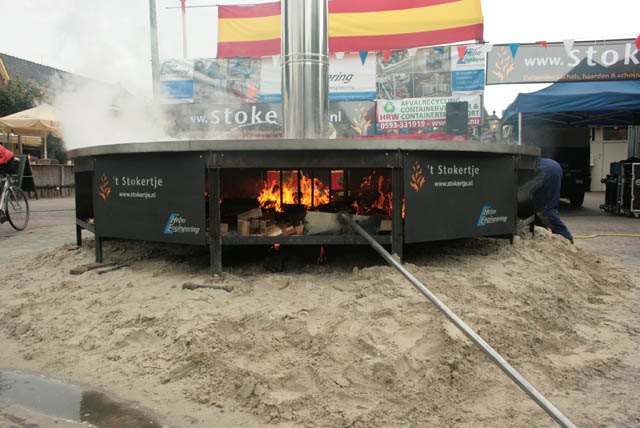
The paella gigante has also made it to the Netherlands. A well-documented example comes from Westerbork, in the province of Drenthe. For the opening of the Spanish Week in 2009, a paella dinner was organised there for some 1,100 to 1,200 people. A special pan was made for the occasion: around five metres across, wood-fired, with a chimney in the middle to carry away the smoke.
The organisers called it the largest paella dinner in the Netherlands. Whether that is official, I don't know; as far as I am aware, there is no Dutch register of paellas. But a five-metre pan in Drenthe is an achievement either way. For comparison: a pan like that has almost fifteen times the surface area of a 130-centimetre pan, the largest size in my calculator.
Is a giant paella still a paella?
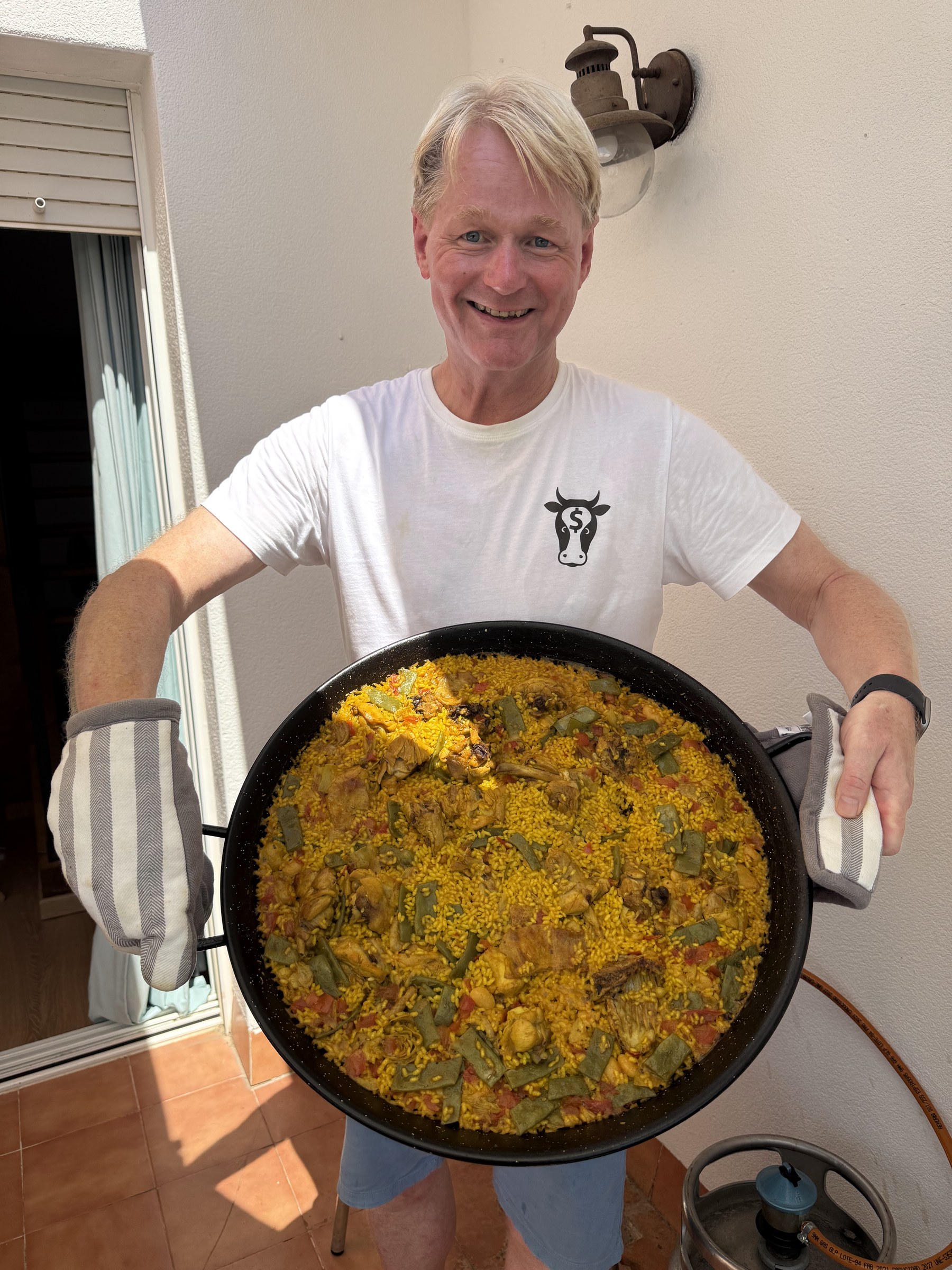
Which brings me to the question that interests me most as a paellero. With a good paella, everything comes down to the balance between the surface of the pan, the rice, the liquid and the heat. The layer of rice is thin, the liquid evaporates over a large surface and the rice cooks evenly, so that the socarrat can form on the bottom. That is also why I cook for groups of no more than fifty people.
I compared the 1992 figures with those of my own calculator. In Valencia, 5,000 kilos of rice went into a pan of more than 300 square metres: about 16 kilos of rice per square metre. My calculator works out at 3 to 4 kilos per square metre; a 90-centimetre pan, for example, takes 1.9 kilos of rice. So the layer of rice in Valencia was four to five times as thick as in my pan. Using my proportions, the record pan would have needed to be 40 to 45 metres across.
And yet I find it a wonderful phenomenon, because it shows what paella is really about: people gathering around a pan, watching the food come together and then eating together. Whether that is with your family, your friends or your whole village.
Prefer a paella on a human scale?
For a thin layer of rice and socarrat across the whole pan, you don't need to have a twenty-metre pan welded together. In my step-by-step blog I show how I make a Paella Valenciana. And with the calculator you can work out how much rice and what size of pan you need for your guests.
Sources
- Guinness World Records — Largest paella
- Galbis Paellas Gigantes — Récord Guinness
- Galbis Paellas Gigantes — Nosotros
- Valencia Bonita — La paella más grande del mundo
- El Valenciano — 8 de marzo de 1992
- Valencia Plaza — Fallece Antonio Galbis
- Wikipedia — Villarriba and Villabajo
- Diario de Avisos — Paella gigante en Bajamar
- Stokertje — Het grootste paelladiner van Nederland