
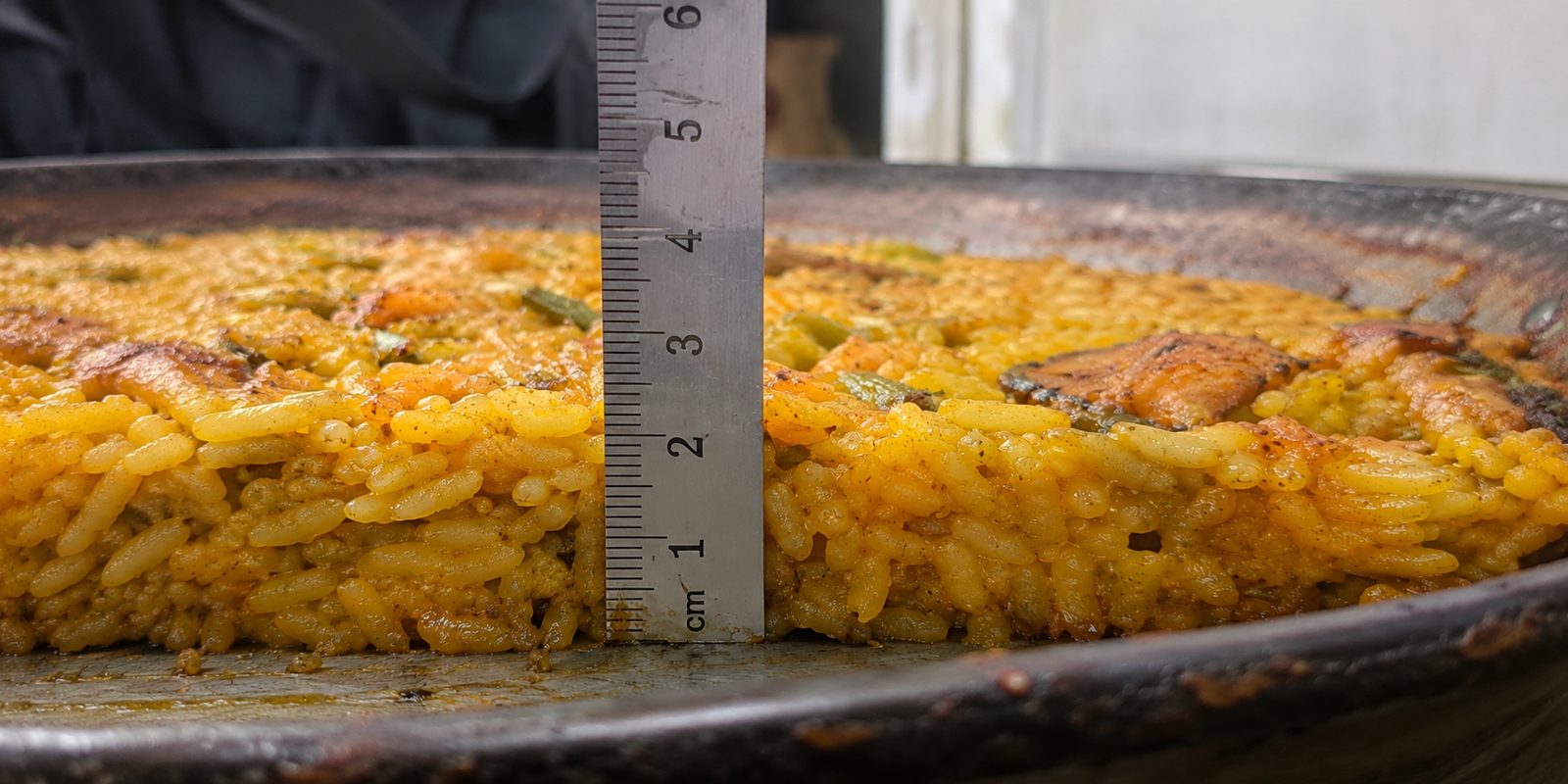
How thick should the rice layer in a paella be?
No aspect of paella divides opinion as much as the amount of rice in the pan. Valencians say the rice should go wide, not high. But how thin is thin? In this article I map out the controversy and measure it: 39 recipes from 16 sources, converted to a single quantity. The spread turns out to be far larger than chance can explain.
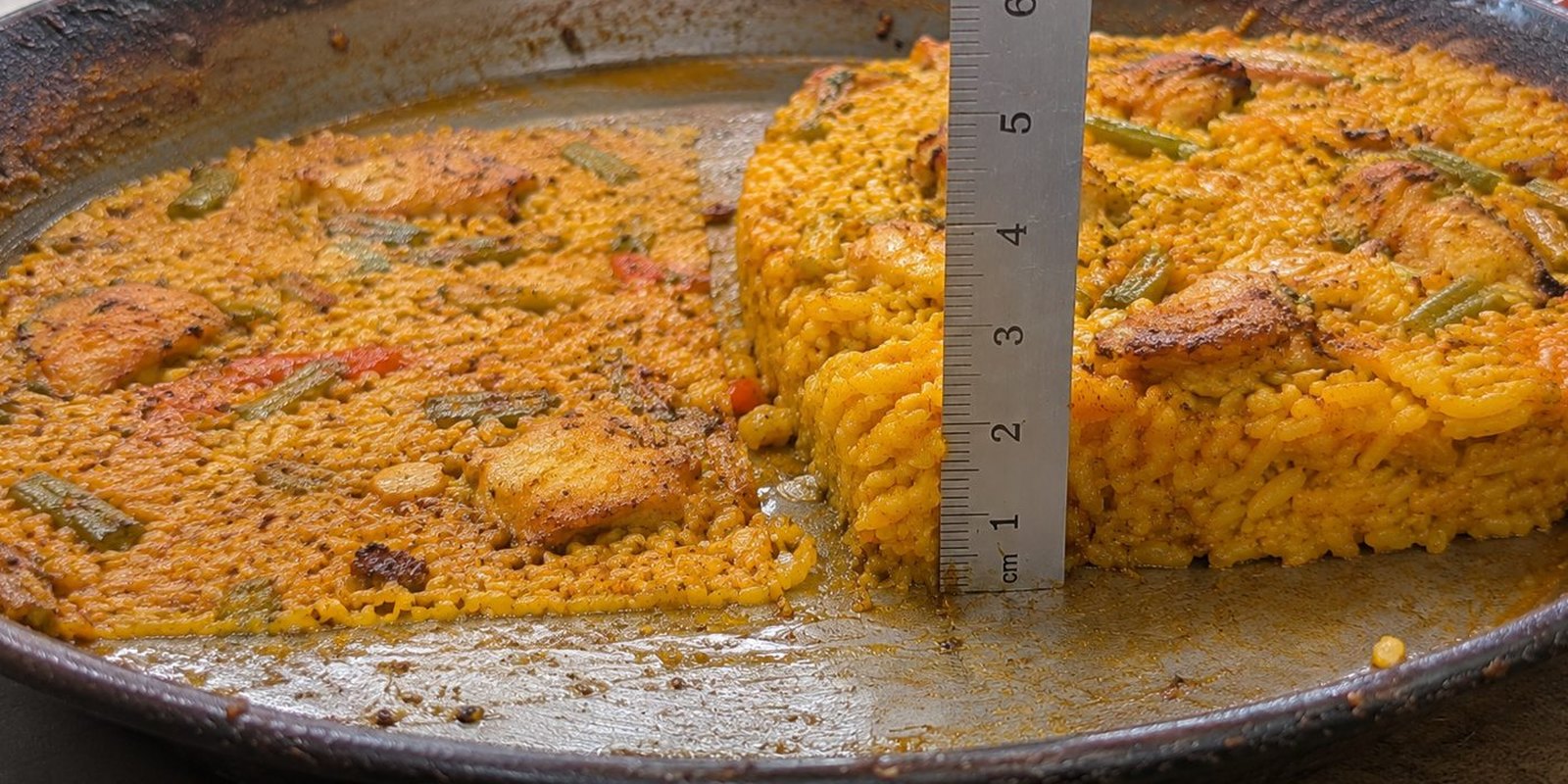
Anyone who makes a paella takes a decision before the fire is even lit that cannot be undone later: how much rice goes into this pan? Too much, and you get a thick layer that you can no longer cook evenly. Too little, and the pan dries out or the rice burns. In between lies the range in which a good paella is possible. Every paellero has firm views on it. Anyone who puts the literature side by side finds that those views contradict each other.
In this article I investigate that question as carefully as I can. Not to declare one recipe the only correct one, but to understand how large the disagreement really is. I map it and quantify it. The analysis builds on an essay I wrote earlier on the subject; for this blog I recalculated every figure from the underlying dataset.
One dogma, many versions
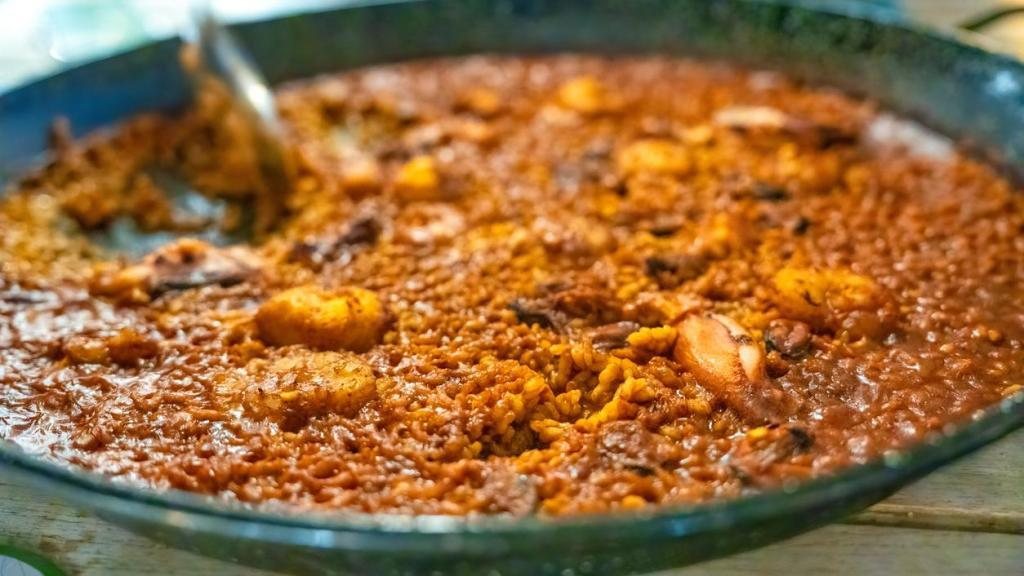
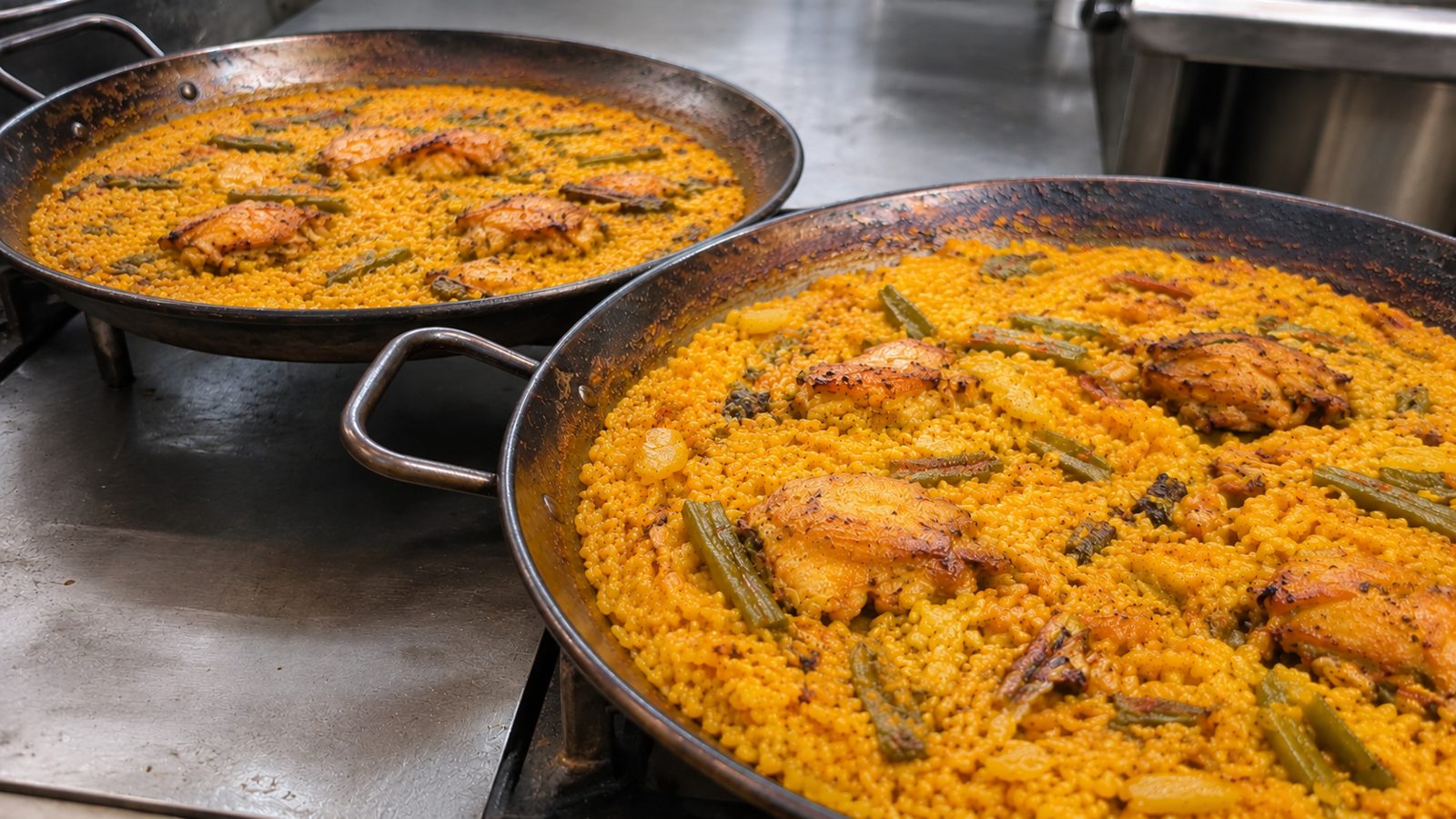
The Valencian rice tradition has a simple rule: paella is cooked en extensión, no en altura, spread wide rather than piled high. Almost everyone agrees on that. On how it translates into an amount of rice, they do not.
The most outspoken is Quique Dacosta, the three-Michelin-star chef from Dénia. For two people he recommends 220 to 240 grams of rice in a pan of about 40 to 42 centimetres, and in his own recipes he goes even lower. In recent years, arroz de capa fina has become a trend in Spanish restaurants. That has drawn a response. The Valencian chef Amadeo Faus warns that too little rice in too large a pan ruins the whole dish: in his view the rice must lie evenly to within half a centimetre of the rim, otherwise the edges burn and the dish turns bitter. What social media shows as socarrat, he says, is often simply burnt rice.
At the other end of the spectrum are cookbooks that feed two or three times as many people from the same pan. The rules of thumb are just as varied: a consumer magazine calls a layer of at most two centimetres ideal, other sources speak of about one centimetre, others of a finger's width. The rice master José Luis Berlanga adds an interesting observation: in larger pans the layer is thinner and the liquid evaporates faster, so you need less stock.
One measure for every pan
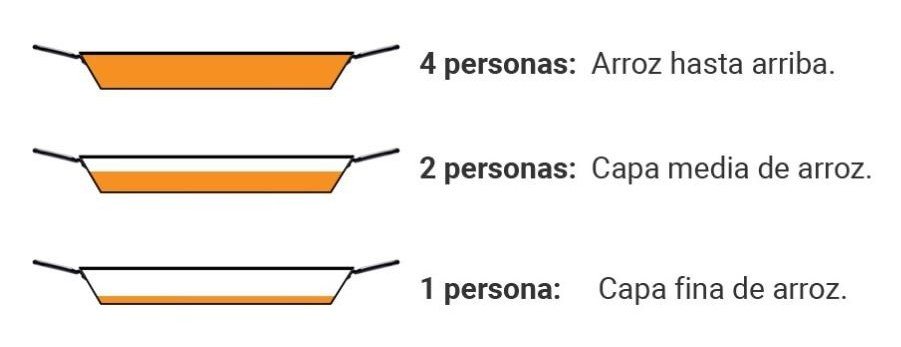
Those rules of thumb are hard to compare. "Two centimetres" can refer to dry or cooked rice, and a finger is not a ruler. Recipes also usually give a number of people or grams for one particular pan, so a recipe for four in 40 centimetres cannot be compared directly with one for ten in 80 centimetres. Conversely, the same pan can serve one, two or four people, as the diagram with figure 1 shows, depending on how full you make it.
I therefore use a single quantity: the surface density ρ, the mass of dry rice per square centimetre of pan area:
ρ = m / A = 4m / (π d²)
where m is the mass of dry rice in grams and d the pan diameter in centimetres. This measure is independent of pan size and of the number of diners. For a 50-centimetre pan (1,963 cm²), ρ = 0.25 g/cm² means, for example, 490 grams of rice.
Figure 1 makes the numbers tangible. A round grain of rice lying flat is about two millimetres high. At 0.10 g/cm² the dry rice is not even one grain thick: there are gaps between the grains. At 0.25 g/cm² it is roughly one and a half layers of grains, at 0.71 g/cm² four to five. During cooking the layer swells considerably.
The data: 39 recipes from 16 sources
For the analysis I collected recipes that state both the amount of rice and the pan diameter, or from which both can be derived unambiguously. That gave 39 data points from 16 sources: Valencian chefs (Quique Dacosta, Vicente Rioja), Spanish cookbook authors (Lourdes March, Simone Ortega, Juan Parra Martí), international cookbooks (Penelope Casas, Culinaria España, Dick Handscombe), recipes from the Comunitat Valenciana and WikiPaella, and my own recipe. Where a source gives a range, for example a pan of 42 to 46 centimetres, I took the midpoint. The full table is at the bottom of this page.
Figure 2 shows the result. If all authors were pursuing the same ideal, the points would cluster around a single dashed line. They do not. They fan out from below the 0.10 g/cm² line to almost the 0.50 line. For a 42.5-centimetre pan you find recipes with 400 grams and with 675 grams. At 50 centimetres they range from 500 to 750 grams.
Vicente Rioja's series also stands out. He scales his recipe from 2 to 10 people and chooses a considerably larger pan at each step. His whole series sits low, between 0.13 and 0.21 g/cm².
How large is the disagreement?
The mean density is 0.288 g/cm², the median 0.282. The standard deviation is 0.104 g/cm², a coefficient of variation of 36 percent. The thinnest recipe (Dacosta, 0.095) and the thickest (Casas, 0.476) differ by a factor of five.
Translated to a 50-centimetre pan: on average 565 grams of rice, but the middle half of the recipes already runs from about 410 to 750 grams. Two cooks who both rely on an authoritative recipe may put almost twice as much rice into the same pan.
Figure 3 shows that the spread is not caused by a single outlier. The sources are spread across the whole axis. Within one source the pattern is usually consistent: whoever cooks thin does so at every pan size. The difference lies between the cooks, not between their recipes.
Noise or genuine disagreement?
Before reading a spread as a difference of opinion, you have to rule out that it is measurement noise. Cookbooks round: 400 or 500 grams, a pan of "about 50 centimetres". How much spread can such inaccuracies produce?
Using Gauss's law of error propagation, ρ = 4m/(πd²) gives for the relative uncertainty:
Δρ/ρ = √[ (Δm/m)² + 4·(Δd/d)² ]
The diameter counts double because it appears squared. Take generous margins: 5 percent for the rice (25 grams in 500) and 2 percent for the pan (1 centimetre in 50). Then Δρ/ρ = √(0.0025 + 0.0016) ≈ 6.4 percent.
The measured coefficient of variation of 36 percent is more than five times larger. A formal chi-square test on the variance gives a test statistic of about 1,200 with 38 degrees of freedom, where pure noise would give a value around 38. The probability that chance produced this is practically zero. The bottom bar in figure 3 shows how narrow the spread would then be.
Systematic errors are also conceivable. Pans are measured at the top rim, while the rice lies on a somewhat smaller base. Some recipes are for paella valenciana, others for rice with fish. Such effects shift the numbers, but they do not explain a factor of five. The conclusion is therefore robust: the spread in the literature is largely genuine disagreement about the desired layer thickness.
The pan trade does not choose either
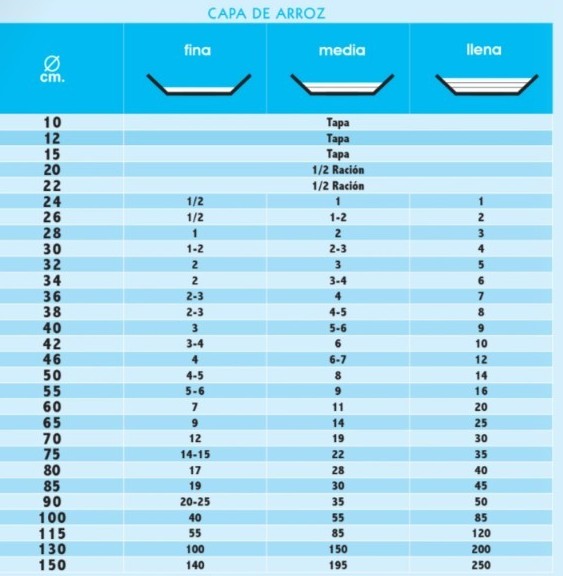
Is the disagreement confined to cooks and authors? Pan maker El Cid sells only to the trade and has no website of its own, but its capacity table circulates among the retailers of its pans. It has three columns: capa fina, capa media and capa llena, a thin, medium and full layer. According to that table, a 50-centimetre pan suits 4 to 5 portions with a thin layer, 8 with a medium layer and 14 with a full layer.
Calculating with 100 grams of rice per portion, a common amount for paella as a main course, the thin layer in that pan comes to 0.23 g/cm², the medium to 0.41 and the full to 0.71. According to the manufacturer, the same pan thus suits a threefold difference in rice. The full layer lies far above anything I found in the cookbooks.
El Cid is not alone. The Valencian shop Original Paella uses a similar table, explicitly based on 100 grams of rice per person. For a 50-centimetre pan it gives 4 to 6 people with a thin layer, 7 to 11 with a medium layer and 12 to 14 with a full layer. That is 0.20 to 0.31 g/cm² for the thin layer and up to 0.71 g/cm² for the full one, practically the same figures as El Cid. Notably, Original Paella equates the thin column with "Valencian".
Figure 4 shows something else. Even El Cid's thin layer is not a fixed density: it rises from 0.21 g/cm² at 30 centimetres to 0.34 at 80 centimetres. Large pans get relatively more rice. Whether there is a physical reason behind this, for instance because a large pan heats and evaporates differently, or whether it is practical rounding, the table cannot tell us.
Three schools
Broadly, the sources fall into three groups. The boundaries are my own working classification, not natural dividing lines.
Very thin (ρ < 0.20 g/cm², 8 recipes). Quique Dacosta and Vicente Rioja. Here the rice forms less than one layer of grains. Supporters cite even cooking, fast evaporation and plenty of socarrat per bite. Critics point to the narrow margin: the liquid runs out quickly and the base burns easily.
Middle zone (0.20–0.35 g/cm², 18 recipes). Most of the recipes: the Comunitat Valenciana, WikiPaella, El Mundo, Handscombe, Laura Paradis and my own recipe. In my calculator, the standard pan always comes out between 0.24 and 0.29 g/cm².
Thick (ρ > 0.35 g/cm², 13 recipes). Penelope Casas, Culinaria España, Juan Parra Martí, three of Lourdes March's four recipes and El Mundo's largest recipe. More diners per pan, but according to traditional criticism also a greater chance that the top grains steam and the bottom ones turn mushy.
The surprise is that the dividing line does not coincide with authenticity. Rioja, an avowed traditionalist, cooks as thin as the avant-gardist Dacosta. Lourdes March, one of the most authoritative writers on Valencian rice cooking, sits in the thick half. The controversy runs right through the Valencian tradition itself.
What the numbers cannot decide
The data show that the cooks disagree, not who is right. Taste plays a part and may legitimately differ. But the arguments each camp uses are claims about what happens in the pan: a thin layer is said to cook more evenly, a thick layer to steam at the top and turn mushy at the bottom, a layer that is too thin to dry out before the grain is cooked. Claims like these can be tested.
At its core this is a race between two clocks. The first is the time a grain needs to absorb water and cook, some seventeen to twenty minutes for Valencian rice. The second is the time in which the liquid disappears from the pan, through absorption by the grains and through evaporation. That second clock depends on the layer thickness, the fire and the pan. If the clocks get out of step, the liquid runs out too early or stays too long. On top of that, the layer is not equally hot everywhere: the base receives the heat of the flame, while the top loses heat and moisture to the air.
Who is right can only be established by measuring, on real paellas with a thin, medium and thick layer.
Conclusion
On the principle, everyone agrees: paella is cooked wide. On the execution, they do not. The 39 recipes in this study differ by a factor of five in rice per square centimetre, with a coefficient of variation of 36 percent. Measurement and rounding errors account for 6 percent at most. Even the makers and sellers of pans offer three layer thicknesses without choosing between them. The culinary literature cannot settle this controversy.
Only measurements on real paellas can tell who is right. That is further research I still intend to do, and I may have to adjust my calculator afterwards. Until then I keep the rice layer thin: in my own paellas and in my calculator around 0.25 g/cm², comparable to the thin layer in El Cid's table.
Appendix: the full dataset (39 recipes and El Cid)
| Source | Recipe | Pan ⌀ (cm) | Rice (g) | ρ (g/cm²) |
|---|---|---|---|---|
| Quique Dacosta | Arròs a banda | 40 | 120 | 0.095 |
| Quique Dacosta | Arroz seco en paella | 45 | 180 | 0.113 |
| Vicente Rioja | Paella 2 p (42-46 cm) | 44 | 200 | 0.132 |
| Vicente Rioja | Paella 3 p (50-55 cm) | 52.5 | 300 | 0.139 |
| Vicente Rioja | Paella 4 p (55-60 cm) | 57.5 | 400 | 0.154 |
| Vicente Rioja | Paella 5 p (60-65 cm) | 62.5 | 500 | 0.163 |
| Vicente Rioja | Paella 6 p (65-70 cm) | 67.5 | 600 | 0.168 |
| Vicente Rioja | Paella 8 p (70 cm) | 70 | 800 | 0.208 |
| Vicente Rioja | Paella 10 p (80 cm) | 80 | 1000 | 0.199 |
| El Mundo (Velarte) | 2 p (36 cm) | 36 | 250 | 0.246 |
| El Mundo (Velarte) | 4 p (50 cm) | 50 | 500 | 0.255 |
| El Mundo (Velarte) | 6 p (55 cm) | 55 | 750 | 0.316 |
| El Mundo (Velarte) | 8 p (60 cm) | 60 | 1000 | 0.354 |
| Hugo Paella (own recipe) | Paella valenciana (50 cm) | 50 | 500 | 0.255 |
| PaellaNL | Paella Valenciana (46 cm) | 46 | 400 | 0.241 |
| Comunitat Valenciana | Paella Valenciana (42-55 cm) | 48.5 | 400 | 0.217 |
| Dick Handscombe | 2 p (35 cm) | 35 | 200 | 0.208 |
| Dick Handscombe | 4 p (42.5 cm) | 42.5 | 400 | 0.282 |
| Dick Handscombe | 6 p (50 cm) | 50 | 600 | 0.306 |
| Dick Handscombe | 8 p (60 cm) | 60 | 800 | 0.283 |
| Lourdes March | 2-3 p (30 cm) | 30 | 250 | 0.354 |
| Lourdes March | 4-5 p (42.5 cm) | 42.5 | 450 | 0.317 |
| Lourdes March | 6-8 p (50 cm) | 50 | 700 | 0.357 |
| Lourdes March | 10 p (55 cm) | 55 | 1000 | 0.421 |
| Ivo Hermans | Moda valenciana (60 cm) | 60 | 700 | 0.248 |
| Juan Parra Martí | Paella (40 cm) | 40 | 500 | 0.398 |
| Juan Parra Martí | Paella de marisc (40 cm) | 40 | 500 | 0.398 |
| Juan Parra Martí | Paella d'anguiles (40 cm) | 40 | 500 | 0.398 |
| Penelope Casas | Scallop paella (42.5 cm) | 42.5 | 550 | 0.388 |
| Penelope Casas | Mussel paella (42.5 cm) | 42.5 | 675 | 0.476 |
| Penelope Casas | Lobster paella (42.5 cm) | 42.5 | 675 | 0.476 |
| Penelope Casas | Black paella (42.5 cm) | 42.5 | 675 | 0.476 |
| Laura Paradis | Paella de pescado (42.5 cm) | 42.5 | 400 | 0.282 |
| Laura Paradis | Arroz a banda (42.5 cm) | 42.5 | 400 | 0.282 |
| Culinaria España | Paella Valenciana (40 cm) | 40 | 500 | 0.398 |
| Culinaria España | Paella Valenciana (50 cm) | 50 | 750 | 0.382 |
| Casa Molero | Fish paella (46 cm) | 46 | 400 | 0.241 |
| Simone Ortega | Paella (47.5 cm) | 47.5 | 600 | 0.339 |
| WikiPaella | Paella Valenciana (43.5 cm) | 43.5 | 400 | 0.269 |
| El Cid | Capa fina (50 cm) | 50 | 450 | 0.229 |
| El Cid | Capa media (50 cm) | 50 | 800 | 0.407 |
| El Cid | Capa llena (50 cm) | 50 | 1400 | 0.713 |
Diameters are top-rim diameters as given by the source; where a range is given, the midpoint is used. For El Cid, 100 grams of rice per portion is assumed, and the midpoint where a range of portions is given. The El Cid points are not included in the statistics of the cookbook recipes.
Sources
- ¡Hola! — 5 tips para la paella perfecta según Quique Dacosta
- Directo al Paladar — Amadeo Faus on arroces de capa fina (2026)
- Directo al Paladar — The right amount of rice according to José Luis Berlanga (2024)
- Eroski Consumer — La mejor paella (2001)
- Comunitat Valenciana — Receta Paella Valenciana
- El Español — Vicente Rioja on paella valenciana (2026)
- El Cid — capacity table Capa de arroz (manufacturer's table, circulated via retailers)
- Original Paella — Table of rations for paella pan size